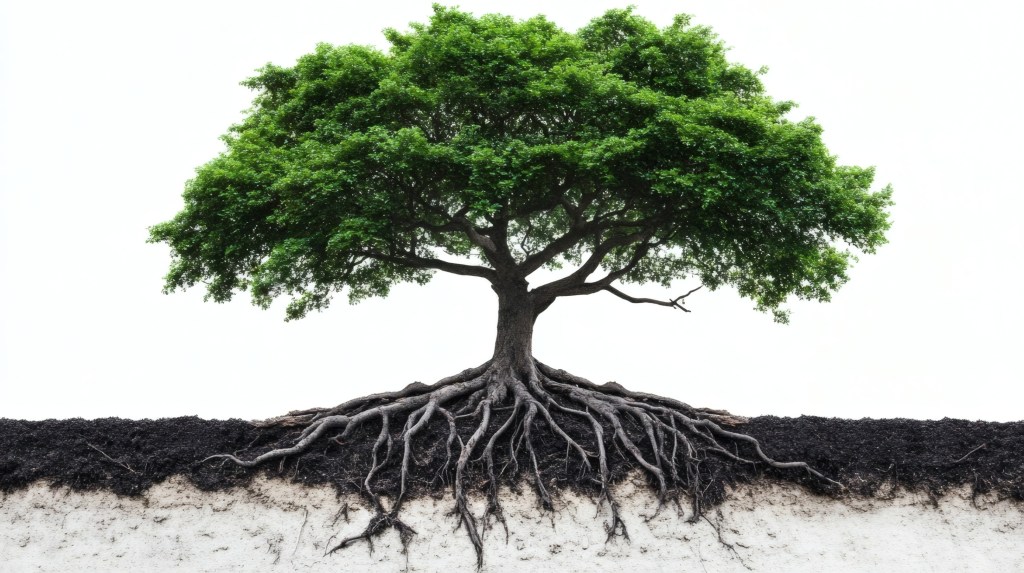
What are your roots chasing?
Shallow roots chase meaning. Deep roots survive seasons when meaning feels lost.
Shallow roots chase meaning because they depend on what is visible.
They reach for success, comfort, approval, productivity, and control, good things, but fragile things. When life is rewarding, shallow roots feel secure. But when the soil dries up, when prayers go unanswered, plans fall apart, or joy feels distant, those same roots find nothing to hold onto. What once felt meaningful suddenly feels empty, and faith begins to feel thin.
Deep roots tell a different story.
They grow slowly, often unseen, formed in seasons of waiting, disappointment, and unanswered questions. Deep roots are not built by having everything make sense, but by returning to God when nothing does. They learn to draw life not from circumstances above the surface, but from the steady, faithful presence of God below it. When meaning feels lost, deep roots don’t panic, they endure.
God is not threatened by our emptiness.
In fact, Scripture shows that He often uses seasons of dryness to drive our roots deeper into Him. When the things we once leaned on fail us, we discover that God has been holding us all along. Meaning is not something we chase; it is something that grows when our lives are rooted in Christ. And while the season may feel barren, what God is doing beneath the surface is anything but wasted.
PURPOSE
The bible teaches, that spiritual growth happens when our lives are deeply rooted in Christ, not shallowly anchored in circumstances.
This session explores what the Bible says when life feels empty, and how God uses those moments to grow our roots deeper.
“Roots don’t grow deep in perfect conditions. They grow deep when the soil is hard.”
Discussion
- What season of life has most challenged your sense of purpose?
- Have you ever felt spiritually dry, even while doing the right thing?
Ask Yourself:
Where do I currently look for meaning, is it above ground or is it deep rooted?
Solomon… “Shallow Satisfaction vs. Deep Meaning”
Let Us Read, Turn with Me To;
Ecclesiastes 1:2–3
“Meaningless! Meaningless! … Everything is meaningless.”
Let Us Discuss:
- What “above-ground fruit” was Solomon chasing (success, pleasure, achievement)?
- Why do these things fail to nourish the soul long-term?
- What happens to a plant that only grows for what’s visible?
You see Solomon isn’t attacking life, he’s warning us that surface-level meaning cannot sustain deep life.
His words in Ecclesiastes are not the complaints of a cynic, but the conclusions of someone who had everything the world promises and still found himself empty. Pleasure, achievement, wisdom, and wealth all produced moments of satisfaction, but none of them could carry the weight of a soul made for eternity. Solomon pulls back the curtain so we can see what happens when good things are asked to become ultimate things.
Surface-level meaning is attractive because it feels immediate and measurable. We can see success, count progress, and feel affirmed. But these sources of meaning are shallow by nature, they depend on circumstances staying favorable. When life shifts, when loss comes, or when joy fades, surface-level meaning collapses. It was never designed to endure the deeper questions of suffering, mortality, and purpose.
Solomon’s warning is actually an invitation. He invites us to stop building our lives on what is temporary and start anchoring our meaning in what is eternal. Deep life requires deep roots, and deep roots are formed when God, not achievement, control, or comfort, becomes the source of meaning. Ecclesiastes doesn’t leave us in despair; it points us toward a wiser way to live, one rooted in reverence for God, where meaning is not manufactured but received.
Job is a powerful example of someone who faced immense trials, yet remained rooted and the evidence tells us through his experiences that the soil he is planted in is that hard soil.
Turn with me to Job 7:16
“My days are a breath… I loathe my life.”
Let Me Ask:
- How does suffering compact the soil of our faith?
- Why do hard seasons often force roots to grow deeper?
- What does Job teach us about honesty before God?
Rooted Truth:
God does not uproot us for asking hard questions.
Scripture shows again and again that God welcomes honest wrestling. Doubt, grief, confusion, and lament these trials, suffering and or emotions are not signs of weak faith; they are often the language of a growing faith. When we bring our hardest questions to God, we are not pushing Him away; we are drawing near with what is real. Silence, suffering, and unanswered prayers do not disqualify us from His presence. They invite us into a deeper trust.
Pain has a way of stripping away surface-level faith. In seasons of comfort, it’s easy to rely on routines, answers, and outcomes. But when pain enters, those supports often fail us. What remains is the deeper question: Who am I rooted in when everything else is shaken? God does not waste these moments. He uses them to loosen our grip on what cannot sustain us and to press our roots further into His faithfulness.
Deep roots are rarely formed in easy soil. They grow when the ground is hard, when growth feels slow, and when progress is invisible. God often uses pain not to punish us, but to strengthen us, to anchor us in something unmovable. Over time, we discover that the very seasons we wished away were the ones that deepened our faith the most. We may not understand the pain, but we learn to trust the One who meets us in it, and that trust becomes the root system that holds us steady for life.
David… Choosing Where Roots Grow
Psalms 39:4–7
“Everyone is but a breath… My hope is in You.”
In Psalm 39:4–7, David openly acknowledges the brevity of life, “Everyone is but a breath.” Yet he does not fall into despair. David understands that recognizing life’s fragility does not remove hope; it clarifies it. When life is short and uncertain, despair only comes when our hope is placed in things that cannot last. David’s hope remains steady because it is not anchored in longevity, success, or stability, but in God Himself. The awareness that life is fleeting drives David toward trust, not hopelessness.
To redirect our roots toward God means intentionally shifting the source of our security and meaning. Instead of drawing life from circumstances, control, or outcomes, we allow our hearts to grow toward God’s faithfulness and presence. Like roots bending toward water, our lives begin to orient around who God is rather than what life provides. This redirection does not remove uncertainty, but it grounds us in something unchanging beneath it.
Prayer becomes the practice that deepens those roots. When life feels unstable, prayer slows us down, reminds us of our dependence, and re-centers our trust. In prayer, we bring our fears, questions, and limitations before God, allowing Him to nourish us where answers are lacking. Over time, prayer transforms uncertainty into trust, not because circumstances improve, but because our roots have grown deeper into the One who holds us steady.
Let’s me ask:
- David agrees life is brief, so why doesn’t he despair?
- What does it mean to redirect your roots toward God?
- How can prayer deepen roots when life feels uncertain?
James – A Living Root Completely Aware
James 4:13–15
“You are a mist that appears for a little while…”
In James 4:13–15, we are reminded that life is fragile and temporary, “a mist that appears for a little while and then vanishes.” This truth invites humility, not fear. Humility keeps our roots flexible because it acknowledges our limits and our dependence on God. When we believe we are in control, our roots become rigid and brittle, breaking when plans fail. Humble faith, however, bends without breaking, trusting God even when the path forward is unclear.
Planning without God is like planting without water. We may have good intentions, careful strategies, and strong effort, but without God as the source of life, growth cannot last. James does not warn us against planning, he warns us against planning as if God were absent. When we submit our plans to the Lord, we allow Him to nourish what we are building, shaping not just the outcome but our hearts in the process.
We stop measuring success solely by visible results and begin valuing faithfulness beneath the surface. Root-aware living asks, Am I becoming more dependent on God? Am I growing in trust? When our focus shifts from controlling outcomes to deepening roots, we discover a steadier, more resilient faith, one that can endure change, delay, and uncertainty with confidence in God’s will.
Let Me Ask:
- How does humility keep our roots flexible instead of brittle?
- Why is planning without God like planting without water?
- What changes when we live root-aware instead of outcome-obsessed?
Paul – The Deepest Root
Paul the Apostle – Philippians 3:7–8
“I consider everything a loss because of the surpassing worth of knowing Christ…”
In Philippians 3:7–8, Paul the Apostle makes a striking declaration: “I consider everything a loss because of the surpassing worth of knowing Christ.” Paul is not dismissing his past achievements or experiences as worthless; he is reordering their value. Compared to knowing Christ, every other source of identity, security, and success loses its power to define him. What once felt essential becomes secondary in the light of something far greater.
This shift reveals where Paul’s roots are truly planted. Rather than drawing life from status, accomplishment, or religious performance, Paul anchors himself in a relationship with Christ. Deep roots require letting go of what once sustained us above the surface so that something stronger can grow beneath it. Paul understands that gaining Christ may mean releasing control, comfort, and even recognition, but what he gains is a life nourished by grace rather than driven by comparison.
When Christ becomes the surpassing worth of our lives, everything else finds its proper place. We stop striving to prove ourselves and begin living from a place of secure belonging. Rooted in Christ, our faith becomes resilient, not because life is easy, but because our source of life is unshakable. Paul’s words invite us to evaluate what we are rooted in and to choose the deeper, lasting life that comes from truly knowing Christ.
Let Me Ask:
- What did Paul willingly let die above ground?
- How does Christ become the nutrient source for everything else?
- What grows naturally when roots are anchored in Jesus?
Life feels meaningless when our roots are shallow.
Life becomes resilient when our roots go deep in Christ.
Meaning is not found in controlling life, it’s found in being rooted in the One who holds life.
ROOT PRACTICE
Choose one practice this week:
- Scripture: Spend 10 minutes daily in one Psalm
- Prayer: Pray honestly, no fixing, no filtering
- Community: Share one struggle with someone you trust
- Release: Let go of one thing you’ve been using for meaning
CLOSING PRAYER
“Jesus, when life feels thin and fragile, help us grow roots instead of chasing fruit.
Anchor us in You. Feed us with truth.
Make us strong, not because life is easy, but because You are faithful.
Amen.”


 DEEP WATERS
Leave a reply to Robert Stephan Cancel reply